// npm install framer-motion

Root element: className="flex min-h-screen w-full items-center justify-center"
The source ships h-full because AI Canvas renders it inside a sized preview frame. A standalone paste needs min-h-screen, or an ancestor with a real height, or the root collapses and takes its absolute layers with it.

Before building, verify your project has the following setup:
- React / Next.js
- TypeScript
- Tailwind CSS v4

If any are missing, set up via the shadcn CLI:
  npx shadcn@latest init

---

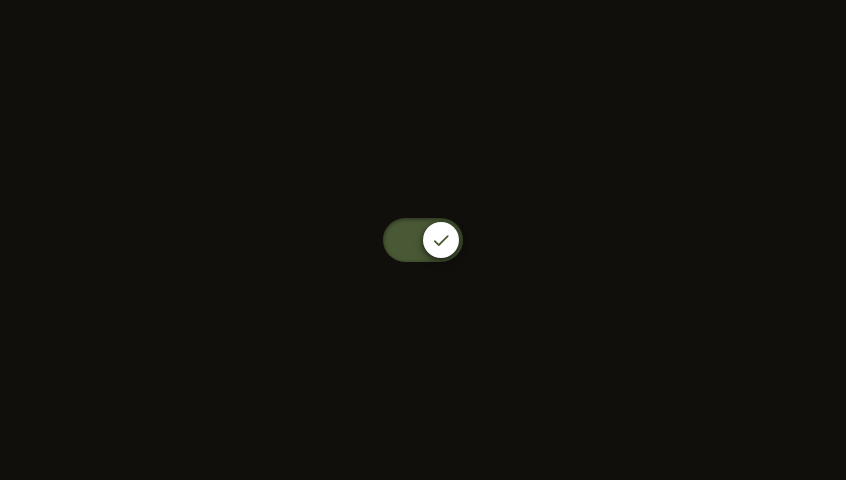
Create a React client component named `TagaToggle`, a playful pill toggle with an expressive face drawn on the thumb. Off = dead face (×× eyes, flat mouth). On = happy face (squinted arc eyes, big smile).

Write this as a single self-contained React client component. Inline everything. Do not extract helper hooks, utility functions, or separate files. 'use client' at the top. No 'any' types.

## Imports
```
'use client'
import { useState, useCallback, useEffect, useRef } from 'react'
import { motion, AnimatePresence, useMotionValue, useTransform, animate } from 'framer-motion'
```

## Constants
`MAX_TRACK_W = 80`, `MIN_TRACK_W = 48`, `FACE_COLOR = '#4A3F35'` (warm dark, legible on white in both themes).

## Derived dimensions (from `trackW` state)
`trackH = round(trackW * 0.58)`
`thumb = round(trackW * 0.50)`
`pad = max(3, round(trackW * 0.04))`
`offX = pad`, `onX = trackW - thumb - pad`
`faceSize = thumb * 0.78`

## Motion values
`thumbX = useMotionValue(offX)`.
`trackColor = useTransform(thumbX, [offX, onX], [offTrack, onTrack])` where:
- `offTrack = pageIsDark ? '#4A4540' : '#9E9890'`
- `onTrack = pageIsDark ? '#D4960A' : '#F5C518'`

## State
`isOn` (bool, default false), `animating` (bool), `pageIsDark` (bool, default true), `trackW` (number, default MAX_TRACK_W).
Keep a `isOnRef = useRef(false)` synchronized with `isOn` to read in the resize snap effect.

## Theme + resize detection (single useEffect)
Get `containerRef.current`. Theme: find `closest('[data-card-theme]')` → if found use `.classList.contains('dark')`, else `document.documentElement.classList.contains('dark')`. MutationObserver on both. Resize: `ResizeObserver` on the container, compute `s = max(MIN_TRACK_W, min(MAX_TRACK_W, round(min(el.offsetWidth, el.offsetHeight) * 0.18)))` → `setTrackW(s)`. Cleanup disconnects both.

## Resize snap (separate useEffect on trackW)
`thumbX.set(isOnRef.current ? onX : offX)` snaps the thumb instantly when the track resizes.

## Toggle handler
`handleToggle` (async, guarded by `animating`): set animating true, compute target (`isOn ? offX : onX`), update `isOnRef`, toggle `isOn`, `await animate(thumbX, target, { type:'spring', stiffness:500, damping:36 })`, set animating false.

## Theme tokens
`previewBg = pageIsDark ? '#110F0C' : '#EDEAE5'`
`trackInset = pageIsDark ? 'inset 0 1px 4px rgba(0,0,0,0.50)' : 'inset 0 1px 3px rgba(0,0,0,0.14)'`
`thumbShadow = pageIsDark ? '0 3px 8px rgba(0,0,0,0.50), 0 1px 3px rgba(0,0,0,0.30)' : '0 3px 8px rgba(0,0,0,0.18), 0 1px 3px rgba(0,0,0,0.10)'`

## Face SVG paths
Mouth (IMPORTANT: both share M+Q structure for smooth Framer Motion path interpolation):
- Off (flat): `'M -0.40,0.43 Q 0,0.43 0.40,0.43'`
- On (smile): `'M -0.40,0.15 Q 0,0.50 0.40,0.15'`

Eye spring: `{ duration: 0.16, ease: [0.34, 1.56, 0.64, 1] }`.

Left eye happy: `<motion.path d="M -0.50,-0.28 Q -0.32,-0.06 -0.14,-0.28" stroke={FACE_COLOR} strokeWidth={0.13} strokeLinecap="round" fill="none" />`
Left eye dead: `<motion.g>` containing two `<line>` elements forming an ×:
- `x1="-0.50" y1="-0.33" x2="-0.14" y2="-0.01"`
- `x1="-0.14" y1="-0.33" x2="-0.50" y2="-0.01"`

Right eye happy: `d="M 0.14,-0.28 Q 0.32,-0.06 0.50,-0.28"`
Right eye dead: same × pattern at (0.14,0.50) positions:
- `x1="0.14" y1="-0.33" x2="0.50" y2="-0.01"`
- `x1="0.50" y1="-0.33" x2="0.14" y2="-0.01"`

All strokes: `stroke={FACE_COLOR} strokeWidth={0.13} strokeLinecap="round"`.

## JSX structure
Root: `<div ref={containerRef} className="flex h-full w-full items-center justify-center" style={{ background: previewBg }}>`.
Entrance: `motion.div initial { opacity:0, scale:0.88 } animate { opacity:1, scale:1 } transition { duration:0.4, ease:[0.34,1.56,0.64,1] }` wrapping the track.

Track: `motion.button` with `style={{ width:trackW, height:trackH, borderRadius:trackH/2, backgroundColor:trackColor, boxShadow:trackInset, position:'relative', cursor:'pointer', border:'none', outline:'none', display:'block' }}`, `whileTap {{ scale: 0.96 }}`, `transition {{ type: 'spring', stiffness: 400, damping: 28 }}`, `onClick={handleToggle}`.

Thumb: `motion.div` inside the track. `style={{ position:'absolute', top:pad, x:thumbX, width:thumb, height:thumb, borderRadius:'50%', background:'white', boxShadow:thumbShadow, display:'flex', alignItems:'center', justifyContent:'center' }}`.

Inside thumb: `<svg viewBox="-1 -1 2 2" width={faceSize} height={faceSize}>`:
- Two `AnimatePresence mode="wait"` blocks (left eye, right eye), each choosing happy arc path or dead × group based on `isOn`. Enter/exit: `initial/exit { opacity:0, scale:0.3 }`, `animate { opacity:1, scale:1 }`, transition = eyeSpring.
- `<motion.path d={mouthPath} stroke={FACE_COLOR} strokeWidth={0.13} strokeLinecap="round" fill="none" transition={{ duration:0.28, ease:'easeInOut' }} />`. The path `d` attribute is set to either the flat or smile path. Because both share the same M+Q structure, Framer Motion interpolates between them smoothly.

Use Manrope font.

## Typography
- Font: project default sans-serif
 AI Canvas