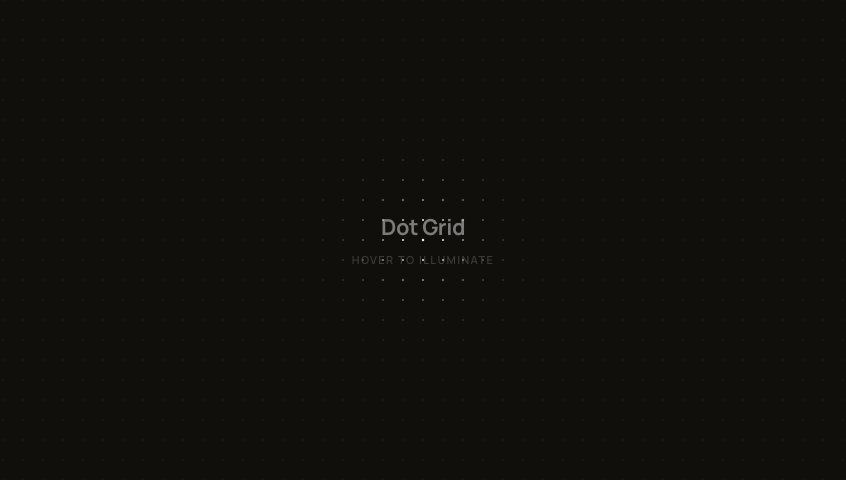
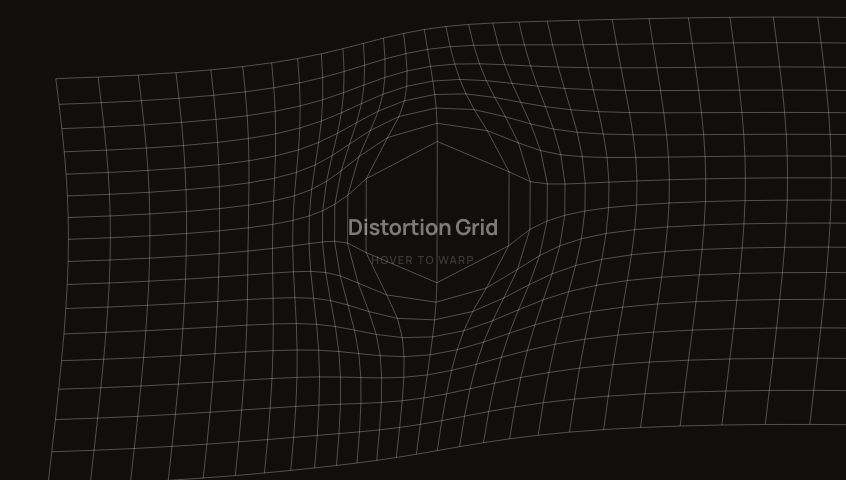
Noise FieldA grid of flowing arrows driven by layered sine-wave noise — like wind mapped on a weather chart.
BackgroundsCanvasInteractive
Switch to light
Refresh
Full screen
'use client'
import { useLayoutEffect, useEffect, useRef, useState } from 'react'
const useIsomorphicLayoutEffect = typeof window !== 'undefined' ? useLayoutEffect : useEffect
// ─── Config ───────────────────────────────────────────────────────────────────
const GRID_SPACING = 24 // px between arrows
const SHAFT_LEN = 8 // half-shaft length
const HEAD_SIZE = 4 // arrowhead branch length
// Cursor-tracking lerp — exponential decay with distance
const DECAY_DIST = 320 // px — wider influence area
const LERP_FAST = 0.12 // lerp speed right at the cursor
const LERP_MIN = 0.006 // minimum speed at large distance
const IDLE_LERP = 0.010 // speed returning to noise flow when cursor is gone
// Organic wobble — each arrow has a personal noise offset so motion feels alive
const WOBBLE_AMP = 0.18 // radians of random drift added on top of cursor angle
const WOBBLE_FREQ = 0.7 // how fast the wobble oscillates per arrow
// ─── Types ────────────────────────────────────────────────────────────────────
interface Arrow {
gx: number
gy: number
angle: number // persistent — lerped toward target each frame
phase: number // unique random phase for organic wobble
}
// ─── Helpers ──────────────────────────────────────────────────────────────────
// Idle noise flow — arrows drift here when no cursor
function flowAngle(gx: number, gy: number, t: number): number {
return (
Math.sin(gx * 0.007 + t) * Math.PI +
Math.cos(gy * 0.007 + t * 0.6) * Math.PI
)
}
// Shortest-path angle lerp — never spins the long way around
function lerpAngle(current: number, target: number, speed: number): number {
let diff = target - current
while (diff > Math.PI) diff -= Math.PI * 2
while (diff < -Math.PI) diff += Math.PI * 2
return current + diff * speed
}
// ─── Component ────────────────────────────────────────────────────────────────
export default function NoiseField() {
const containerRef = useRef<HTMLDivElement>(null)
const canvasRef = useRef<HTMLCanvasElement>(null)
const [isDark, setIsDark] = useState(() => typeof window !== 'undefined' ? document.documentElement.classList.contains('dark') : false)
const isDarkRef = useRef(isDark)
const mouseRef = useRef<{ x: number; y: number } | null>(null)
const arrowsRef = useRef<Arrow[]>([])
useIsomorphicLayoutEffect(() => { isDarkRef.current = isDark }, [isDark])
// ── Theme detection ───────────────────────────────────────────────────────
useIsomorphicLayoutEffect(() => {
const el = containerRef.current
if (!el) return
const check = () => {
const card = el.closest('[data-card-theme]')
const dark = card
? card.classList.contains('dark')
: document.documentElement.classList.contains('dark')
setIsDark(dark)
isDarkRef.current = dark
}
check()
const observer = new MutationObserver(check)
observer.observe(document.documentElement, { attributes: true, attributeFilter: ['class'] })
const cw = el.closest('[data-card-theme]')
if (cw) observer.observe(cw, { attributes: true, attributeFilter: ['class'] })
return () => observer.disconnect()
}, [])
// ── Mouse tracking ────────────────────────────────────────────────────────
useEffect(() => {
const canvas = canvasRef.current
if (!canvas) return
const onMove = (e: MouseEvent) => {
const rect = canvas.getBoundingClientRect()
mouseRef.current = { x: e.clientX - rect.left, y: e.clientY - rect.top }
}
const onLeave = () => { mouseRef.current = null }
canvas.addEventListener('mousemove', onMove)
canvas.addEventListener('mouseleave', onLeave)
return () => {
canvas.removeEventListener('mousemove', onMove)
canvas.removeEventListener('mouseleave', onLeave)
}
}, [])
// ── Main draw loop ────────────────────────────────────────────────────────
useEffect(() => {
const canvas = canvasRef.current
const container = containerRef.current
if (!canvas || !container) return
const ctx = canvas.getContext('2d')
if (!ctx) return
let rafId: number
let t = 0
function buildGrid(W: number, H: number) {
// Preserve existing angles when grid is rebuilt on resize
const prev = new Map<string, Arrow>()
for (const a of arrowsRef.current) prev.set(`${a.gx},${a.gy}`, a)
const next: Arrow[] = []
for (let gx = GRID_SPACING / 2; gx < W; gx += GRID_SPACING) {
for (let gy = GRID_SPACING / 2; gy < H; gy += GRID_SPACING) {
const existing = prev.get(`${gx},${gy}`)
next.push({
gx,
gy,
angle: existing?.angle ?? flowAngle(gx, gy, t),
phase: existing?.phase ?? Math.random() * Math.PI * 2,
})
}
}
arrowsRef.current = next
}
const resize = () => {
const w = container.clientWidth || 480
const h = container.clientHeight || 480
const dpr = window.devicePixelRatio || 1
canvas.width = w * dpr
canvas.height = h * dpr
canvas.style.width = `${w}px`
canvas.style.height = `${h}px`
ctx.setTransform(dpr, 0, 0, dpr, 0, 0)
buildGrid(w, h)
}
resize()
const ro = new ResizeObserver(resize)
ro.observe(container)
function draw() {
const W = container!.clientWidth || 480
const H = container!.clientHeight || 480
const dark = isDarkRef.current
const mouse = mouseRef.current
// Background
ctx!.fillStyle = dark ? '#110F0C' : '#F5F1EA'
ctx!.fillRect(0, 0, W, H)
ctx!.lineCap = 'round'
ctx!.lineJoin = 'round'
for (const arrow of arrowsRef.current) {
const { gx, gy } = arrow
if (mouse) {
// Point toward cursor — each arrow lerps at its own distance-based speed
const dx = mouse.x - gx
const dy = mouse.y - gy
const dist = Math.sqrt(dx * dx + dy * dy)
// Organic wobble: personal sine offset that scales down close to cursor
const proximityFactor = Math.exp(-dist / DECAY_DIST)
const wobble = WOBBLE_AMP * (1 - proximityFactor * 0.7) * Math.sin(t * WOBBLE_FREQ + arrow.phase)
const targetAngle = Math.atan2(dy, dx) + wobble
const speed = LERP_FAST * proximityFactor + LERP_MIN
arrow.angle = lerpAngle(arrow.angle, targetAngle, speed)
} else {
// Slowly drift back to noise flow (wobble persists here too for life)
const noiseAngle = flowAngle(gx, gy, t) + WOBBLE_AMP * 0.5 * Math.sin(t * WOBBLE_FREQ * 0.8 + arrow.phase)
arrow.angle = lerpAngle(arrow.angle, noiseAngle, IDLE_LERP)
}
const angle = arrow.angle
const cos = Math.cos(angle)
const sin = Math.sin(angle)
// Alpha — distance-based fade: far arrows almost invisible, close ones bright
let alpha: number
if (mouse) {
const dx = mouse.x - gx, dy = mouse.y - gy
const dist2 = dx * dx + dy * dy
// Tight gaussian — drops off steeply beyond ~200px, near-zero by ~420px
const proximity = Math.exp(-dist2 / (200 * 200))
alpha = dark
? 0.06 + proximity * 0.84
: 0.05 + proximity * 0.75
} else {
// Idle: gentle uniform low opacity — field is barely there without cursor
alpha = dark ? 0.18 : 0.15
}
const color = dark
? `rgba(255,255,255,${alpha.toFixed(3)})`
: `rgba(28,25,22,${alpha.toFixed(3)})`
ctx!.strokeStyle = color
const tipX = gx + cos * SHAFT_LEN
const tipY = gy + sin * SHAFT_LEN
const tailX = gx - cos * SHAFT_LEN
const tailY = gy - sin * SHAFT_LEN
// Shaft
ctx!.lineWidth = 1.2
ctx!.beginPath()
ctx!.moveTo(tailX, tailY)
ctx!.lineTo(tipX, tipY)
ctx!.stroke()
// Arrowhead — tighter V (144°)
const headAngle = Math.PI - Math.PI / 5
ctx!.lineWidth = 1.0
ctx!.beginPath()
ctx!.moveTo(tipX, tipY)
ctx!.lineTo(
tipX + Math.cos(angle + headAngle) * HEAD_SIZE,
tipY + Math.sin(angle + headAngle) * HEAD_SIZE,
)
ctx!.stroke()
ctx!.beginPath()
ctx!.moveTo(tipX, tipY)
ctx!.lineTo(
tipX + Math.cos(angle - headAngle) * HEAD_SIZE,
tipY + Math.sin(angle - headAngle) * HEAD_SIZE,
)
ctx!.stroke()
}
t += 0.004
rafId = requestAnimationFrame(draw)
}
rafId = requestAnimationFrame(draw)
return () => {
cancelAnimationFrame(rafId)
ro.disconnect()
}
}, [])
return (
<div
ref={containerRef}
className="relative min-h-screen w-full overflow-hidden"
style={{ background: isDark ? '#110F0C' : '#F5F1EA' }}
>
<canvas ref={canvasRef} className="absolute inset-0" />
</div>
)
}
Add to your project
One command adds this component to your project.
1
Run the following command. New project? Run npx shadcn@latest init first to set up Tailwind and path aliases.
npx shadcn@latest add @aicanvas/noise-field2
For dark mode, add the dark class to your <html> element:
<html class="dark">