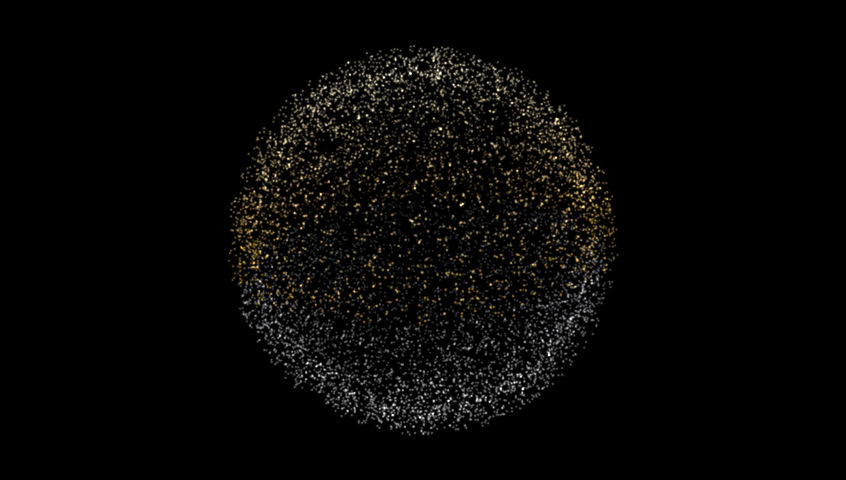
Curious AIA morphing 3D AI orb in Three.js with cyan and magenta rim lights, iridescent pink speckles on a wrinkled surface, and glowing pink robot-eye pills that follow your cursor and blink between idle looks.
3D & ShadersThree.jsInteractive
Switch to light
Refresh
Full screen
'use client'
// npm install three framer-motion
import { useEffect, useRef, useState } from 'react'
import { motion, useMotionValue, useSpring } from 'framer-motion'
import * as THREE from 'three'
// Inline theme reader — observes `.dark` on `<html>` and an optional
// `[data-card-theme]` ancestor (per-card override on the homepage grid).
// Kept inline so this file is self-contained when copy-pasted.
function useScopedTheme(ref: React.RefObject<HTMLElement | null>) {
const [theme, setTheme] = useState<'light' | 'dark'>('dark')
useEffect(() => {
const element = ref.current
if (!element) return
const readTheme = () => {
const scope = element.closest('[data-card-theme]') as HTMLElement | null
if (scope) {
setTheme(scope.dataset.cardTheme === 'dark' ? 'dark' : 'light')
return
}
setTheme(document.documentElement.classList.contains('dark') ? 'dark' : 'light')
}
readTheme()
const observers: MutationObserver[] = []
let current: HTMLElement | null = element
while (current) {
const obs = new MutationObserver(readTheme)
obs.observe(current, { attributes: true, attributeFilter: ['class', 'data-card-theme'] })
observers.push(obs)
current = current.parentElement
}
const htmlObs = new MutationObserver(readTheme)
htmlObs.observe(document.documentElement, { attributes: true, attributeFilter: ['class'] })
observers.push(htmlObs)
return () => observers.forEach((o) => o.disconnect())
}, [ref])
return theme
}
// ─── Shaders ──────────────────────────────────────────────────────────────────
const VERT = /* glsl */ `
uniform float uTime;
uniform float uActive; // 0..1 lerp toward "alert"
uniform vec2 uLook; // -1..1, current look direction (cursor or idle script)
uniform float uReduce; // 1 = motion allowed, 0 = motion frozen
varying vec3 vNormal;
varying vec3 vViewDir;
varying vec3 vLocalPos; // original mesh position — for stable surface speckles
varying vec3 vViewPos; // view-space position — fragment derives the displaced normal from this
// Classic 3D simplex noise — Ashima Arts / Stefan Gustavson, MIT.
vec3 mod289(vec3 x){return x-floor(x*(1./289.))*289.;}
vec4 mod289(vec4 x){return x-floor(x*(1./289.))*289.;}
vec4 permute(vec4 x){return mod289(((x*34.)+1.)*x);}
vec4 taylorInvSqrt(vec4 r){return 1.79284291400159-0.85373472095314*r;}
float snoise(vec3 v){
const vec2 C=vec2(1./6.,1./3.);
const vec4 D=vec4(0.,.5,1.,2.);
vec3 i=floor(v+dot(v,C.yyy));
vec3 x0=v-i+dot(i,C.xxx);
vec3 g=step(x0.yzx,x0.xyz);
vec3 l=1.-g;
vec3 i1=min(g.xyz,l.zxy);
vec3 i2=max(g.xyz,l.zxy);
vec3 x1=x0-i1+C.xxx;
vec3 x2=x0-i2+C.yyy;
vec3 x3=x0-D.yyy;
i=mod289(i);
vec4 p=permute(permute(permute(
i.z+vec4(0.,i1.z,i2.z,1.))
+ i.y+vec4(0.,i1.y,i2.y,1.))
+ i.x+vec4(0.,i1.x,i2.x,1.));
float n_=1./7.;
vec3 ns=n_*D.wyz-D.xzx;
vec4 j=p-49.*floor(p*ns.z*ns.z);
vec4 x_=floor(j*ns.z);
vec4 y_=floor(j-7.*x_);
vec4 x=x_*ns.x+ns.yyyy;
vec4 y=y_*ns.x+ns.yyyy;
vec4 h=1.-abs(x)-abs(y);
vec4 b0=vec4(x.xy,y.xy);
vec4 b1=vec4(x.zw,y.zw);
vec4 s0=floor(b0)*2.+1.;
vec4 s1=floor(b1)*2.+1.;
vec4 sh=-step(h,vec4(0.));
vec4 a0=b0.xzyw+s0.xzyw*sh.xxyy;
vec4 a1=b1.xzyw+s1.xzyw*sh.zzww;
vec3 p0=vec3(a0.xy,h.x);
vec3 p1=vec3(a0.zw,h.y);
vec3 p2=vec3(a1.xy,h.z);
vec3 p3=vec3(a1.zw,h.w);
vec4 norm=taylorInvSqrt(vec4(dot(p0,p0),dot(p1,p1),dot(p2,p2),dot(p3,p3)));
p0*=norm.x;p1*=norm.y;p2*=norm.z;p3*=norm.w;
vec4 m=max(.6-vec4(dot(x0,x0),dot(x1,x1),dot(x2,x2),dot(x3,x3)),0.);
m=m*m;
return 42.*dot(m*m,vec4(dot(p0,x0),dot(p1,x1),dot(p2,x2),dot(p3,x3)));
}
void main(){
vLocalPos = position; // stable surface coord — speckles stick here
vec3 pos = position;
float t = uTime * uReduce;
// Slow anisotropic stretch — orb morphs through ovoid orientations over time.
float ax = sin(t * 0.27 + 0.0) * 0.16;
float ay = sin(t * 0.19 + 1.7) * 0.20;
float az = sin(t * 0.23 + 3.1) * 0.12;
pos *= vec3(1.0 + ax, 1.0 + ay, 1.0 + az);
// Two octaves — keep the surface glossier/smoother for the new aesthetic.
float nLow = snoise(pos * 0.55 + vec3( t * 0.18, t * 0.13, -t * 0.15));
float nMid = snoise(pos * 1.45 + vec3(-t * 0.22, t * 0.20, t * 0.18));
// Look direction biases the noise sample — the "face" bulges where it looks.
vec3 lookDir = vec3(uLook, 0.55);
float facing = clamp(dot(normalize(pos), normalize(lookDir)), 0.0, 1.0);
float bulge = pow(facing, 2.5) * (0.08 + uActive * 0.10);
// Gentle breath — overall radial pulse, very slow.
float breath = sin(t * 0.55) * 0.022;
float amp = mix(0.20, 0.34, uActive);
float displacement = (nLow * 0.66 + nMid * 0.34) * amp + bulge + breath;
pos += normal * displacement;
vec4 mv = modelViewMatrix * vec4(pos, 1.0);
vNormal = normalize(normalMatrix * normal);
vViewDir = normalize(-mv.xyz);
vViewPos = mv.xyz;
gl_Position = projectionMatrix * mv;
}
`
const FRAG = /* glsl */ `
precision highp float;
uniform vec3 uBase;
uniform vec3 uRimA; // cyan rim (upper-left light)
uniform vec3 uRimB; // magenta rim (lower-right light)
uniform vec3 uSpeckA; // electric pink speckle
uniform vec3 uSpeckB; // electric cyan speckle
uniform float uActive;
varying vec3 vNormal;
varying vec3 vViewDir;
varying vec3 vLocalPos;
varying vec3 vViewPos;
// Simplex 3D noise — same as vertex, needed for speckle sampling.
vec3 mod289(vec3 x){return x-floor(x*(1./289.))*289.;}
vec4 mod289(vec4 x){return x-floor(x*(1./289.))*289.;}
vec4 permute(vec4 x){return mod289(((x*34.)+1.)*x);}
vec4 taylorInvSqrt(vec4 r){return 1.79284291400159-0.85373472095314*r;}
float snoise(vec3 v){
const vec2 C=vec2(1./6.,1./3.);
const vec4 D=vec4(0.,.5,1.,2.);
vec3 i=floor(v+dot(v,C.yyy));
vec3 x0=v-i+dot(i,C.xxx);
vec3 g=step(x0.yzx,x0.xyz);
vec3 l=1.-g;
vec3 i1=min(g.xyz,l.zxy);
vec3 i2=max(g.xyz,l.zxy);
vec3 x1=x0-i1+C.xxx;
vec3 x2=x0-i2+C.yyy;
vec3 x3=x0-D.yyy;
i=mod289(i);
vec4 p=permute(permute(permute(
i.z+vec4(0.,i1.z,i2.z,1.))
+ i.y+vec4(0.,i1.y,i2.y,1.))
+ i.x+vec4(0.,i1.x,i2.x,1.));
float n_=1./7.;
vec3 ns=n_*D.wyz-D.xzx;
vec4 j=p-49.*floor(p*ns.z*ns.z);
vec4 x_=floor(j*ns.z);
vec4 y_=floor(j-7.*x_);
vec4 x=x_*ns.x+ns.yyyy;
vec4 y=y_*ns.x+ns.yyyy;
vec4 h=1.-abs(x)-abs(y);
vec4 b0=vec4(x.xy,y.xy);
vec4 b1=vec4(x.zw,y.zw);
vec4 s0=floor(b0)*2.+1.;
vec4 s1=floor(b1)*2.+1.;
vec4 sh=-step(h,vec4(0.));
vec4 a0=b0.xzyw+s0.xzyw*sh.xxyy;
vec4 a1=b1.xzyw+s1.xzyw*sh.zzww;
vec3 p0=vec3(a0.xy,h.x);
vec3 p1=vec3(a0.zw,h.y);
vec3 p2=vec3(a1.xy,h.z);
vec3 p3=vec3(a1.zw,h.w);
vec4 norm=taylorInvSqrt(vec4(dot(p0,p0),dot(p1,p1),dot(p2,p2),dot(p3,p3)));
p0*=norm.x;p1*=norm.y;p2*=norm.z;p3*=norm.w;
vec4 m=max(.6-vec4(dot(x0,x0),dot(x1,x1),dot(x2,x2),dot(x3,x3)),0.);
m=m*m;
return 42.*dot(m*m,vec4(dot(p0,x0),dot(p1,x1),dot(p2,x2),dot(p3,x3)));
}
void main(){
// True surface normal derived from view-space position derivatives — picks
// up the actual wrinkles/ridges from the displaced geometry instead of the
// smooth icosahedron normal. Gives proper shadow-in-valley, highlight-on-
// ridge shading.
vec3 dx = dFdx(vViewPos);
vec3 dy = dFdy(vViewPos);
vec3 n = normalize(cross(dx, dy));
vec3 v = normalize(-vViewPos);
// Fresnel — bright at glancing angles, dark where the surface faces us.
float fres = 1.0 - clamp(dot(n, v), 0.0, 1.0);
// ── Diffuse 3D lighting on the body ───────────────────────────────────────
// Two soft lights: warm-cyan key from upper-left-front, cool-magenta fill
// from lower-right. Combined with derivative normal, this makes wrinkle
// ridges catch light and valleys fall into shadow.
vec3 keyDir = normalize(vec3(-0.45, 0.70, 0.85));
vec3 fillDir = normalize(vec3( 0.65, -0.35, 0.55));
float diffKey = max(0.0, dot(n, keyDir));
float diffFill = max(0.0, dot(n, fillDir));
// Ambient + key + fill — wrap the body in directional light so ridges and
// valleys actually read as 3D.
vec3 lit = uBase * (0.30 + diffKey * 0.95 + diffFill * 0.45);
// ── Two-tone rim lights ──────────────────────────────────────────────────
vec3 dirCyan = normalize(vec3(-0.70, 0.55, 0.50));
vec3 dirMagenta = normalize(vec3( 0.75, -0.30, 0.50));
float cyanWrap = max(0.0, dot(n, dirCyan));
float magentaWrap = max(0.0, dot(n, dirMagenta));
float rimCoreP = mix(2.2, 1.7, uActive);
float rimCyan = pow(cyanWrap, 1.3) * pow(fres, rimCoreP);
float rimMagenta = pow(magentaWrap, 1.3) * pow(fres, rimCoreP);
// ── Specular highlight on ridges ─────────────────────────────────────────
// Blinn-half-vector style spec from the key light — puts a moving glint on
// ridges that face the light, sells the glossy / wet quality.
vec3 halfKey = normalize(keyDir + v);
float specKey = pow(max(0.0, dot(n, halfKey)), 32.0) * 0.55;
vec3 col = lit
+ uRimA * rimCyan * mix(1.10, 1.55, uActive)
+ uRimB * rimMagenta * mix(1.00, 1.45, uActive)
+ specKey * vec3(0.80, 0.95, 1.00);
// ── Iridescent speckles (sparser than before) ────────────────────────────
// Higher thresholds → ~half the previous density. Single big-scale layer
// with a small-scale accent.
float speckBig = snoise(vLocalPos * 10.0);
float speckSmall = snoise(vLocalPos * 24.0 + 1.7);
float maskBig = smoothstep(0.66, 0.74, speckBig);
float maskSmall = smoothstep(0.72, 0.78, speckSmall) * 0.40;
float speckMask = max(maskBig, maskSmall);
// Per-cluster colour pick — biased toward pink, with cyan accents.
float colorPick = snoise(vLocalPos * 4.0 + 5.3);
vec3 speckColor = mix(uSpeckA, uSpeckB, smoothstep(0.55, 0.75, colorPick));
// Fade speckles in valley shadows so they read as surface, not stickers.
float speckBody = 1.0 - smoothstep(0.55, 0.95, fres);
col += speckColor * speckMask * speckBody * 0.85;
gl_FragColor = vec4(col, 1.0);
}
`
// ─── Theme palette ────────────────────────────────────────────────────────────
// Dark teal body with two-tone rim (cyan / magenta) and iridescent pink+cyan
// speckles — same on both themes since the orb is intrinsically dark.
type Palette = {
base: [number, number, number]
rimA: [number, number, number] // cyan rim — upper-left light
rimB: [number, number, number] // magenta rim — lower-right light
speckA: [number, number, number] // electric pink speckle
speckB: [number, number, number] // electric cyan speckle
eye: string
eyeGlow: string
}
const PALETTE: Record<'dark' | 'light', Palette> = {
dark: {
base: [0.050, 0.075, 0.085],
rimA: [0.380, 0.860, 0.940],
rimB: [0.730, 0.330, 0.940],
speckA: [0.880, 0.275, 0.985],
speckB: [0.400, 0.910, 1.000],
eye: 'rgba(255, 140, 245, 0.85)', // hot pink — slightly translucent so it glows rather than reads solid
eyeGlow: 'rgba(225, 90, 230, 0.70)', // saturated magenta halo
},
light: {
base: [0.075, 0.105, 0.120],
rimA: [0.400, 0.870, 0.940],
rimB: [0.745, 0.355, 0.940],
speckA: [0.895, 0.290, 0.985],
speckB: [0.420, 0.915, 1.000],
eye: 'rgba(255, 150, 248, 0.88)',
eyeGlow: 'rgba(225, 100, 230, 0.75)',
},
}
// ─── Idle look-around script ─────────────────────────────────────────────────
// left → slightly right → slightly left → top → back, then loop.
// x and y are in normalised stage coords (-1..1). y is "up = negative".
const LOOK_SEQUENCE: { x: number; y: number; dur: number }[] = [
{ x: -0.65, y: 0.00, dur: 2400 }, // left
{ x: 0.32, y: 0.00, dur: 2800 }, // slightly right
{ x: -0.24, y: 0.00, dur: 2200 }, // slightly left
{ x: 0.00, y: -0.55, dur: 2800 }, // top
{ x: 0.00, y: 0.00, dur: 2600 }, // back
]
// ─── Component ────────────────────────────────────────────────────────────────
export default function CuriousAi() {
const containerRef = useRef<HTMLDivElement>(null) // outer chrome — theme scope
const stageRef = useRef<HTMLDivElement>(null) // inner square — pointer events + rect
const canvasRef = useRef<HTMLDivElement>(null) // canvas host
const sizeRef = useRef({ w: 320, h: 320 })
// One source of truth for "where is the orb looking?":
// pointer overrides during hover, idle script drives otherwise.
const lookTargetRef = useRef({ x: 0, y: 0 }) // desired
const lookCurrentRef = useRef({ x: 0, y: 0 }) // smoothed
const hoverActiveRef = useRef(false)
// Alertness — how "awake" the orb is. Driven by hover/touch.
const activeRef = useRef(0)
const targetRef = useRef(0)
// Eye HTML offset — driven from RAF loop using lookCurrentRef.
const eyeX = useMotionValue(0)
const eyeY = useMotionValue(0)
const sx = useSpring(eyeX, { stiffness: 200, damping: 22, mass: 0.4 })
const sy = useSpring(eyeY, { stiffness: 200, damping: 22, mass: 0.4 })
const [blinkAt, setBlinkAt] = useState(0)
// Eye open-state: idle (off-page) = 0.85, in container = 0.70, on orb = 0.32 (shrink).
const [open, setOpen] = useState(0.85)
const theme = useScopedTheme(containerRef)
// ── Three.js scene ──────────────────────────────────────────────────────────
useEffect(() => {
const host = canvasRef.current
if (!host) return
const W = host.clientWidth || 320
const H = host.clientHeight || 320
sizeRef.current = { w: W, h: H }
const palette = PALETTE[theme]
const scene = new THREE.Scene()
const camera = new THREE.PerspectiveCamera(38, W / H, 0.1, 100)
camera.position.z = 4.4
// Transparent canvas — the orb breathes against whatever page bg is behind.
const renderer = new THREE.WebGLRenderer({ antialias: true, alpha: true })
renderer.setPixelRatio(Math.min(window.devicePixelRatio, 2))
renderer.setSize(W, H)
renderer.setClearColor(0x000000, 0)
host.appendChild(renderer.domElement)
const detail = W < 400 ? 32 : 64
const geo = new THREE.IcosahedronGeometry(1, detail)
const uniforms: Record<string, THREE.IUniform> = {
uTime: { value: 0 },
uActive: { value: 0 },
uLook: { value: new THREE.Vector2(0, 0) },
uReduce: { value: 1 },
uBase: { value: new THREE.Color(...palette.base) },
uRimA: { value: new THREE.Color(...palette.rimA) },
uRimB: { value: new THREE.Color(...palette.rimB) },
uSpeckA: { value: new THREE.Color(...palette.speckA) },
uSpeckB: { value: new THREE.Color(...palette.speckB) },
}
const mat = new THREE.ShaderMaterial({
vertexShader: VERT,
fragmentShader: FRAG,
uniforms,
transparent: true,
})
const mesh = new THREE.Mesh(geo, mat)
scene.add(mesh)
const mql = window.matchMedia('(prefers-reduced-motion: reduce)')
const applyMotion = () => { uniforms.uReduce.value = mql.matches ? 0 : 1 }
applyMotion()
mql.addEventListener('change', applyMotion)
const ro = new ResizeObserver((entries) => {
const r = entries[0]?.contentRect
if (!r) return
const nw = Math.max(1, Math.floor(r.width))
const nh = Math.max(1, Math.floor(r.height))
sizeRef.current = { w: nw, h: nh }
renderer.setSize(nw, nh)
camera.aspect = nw / nh
camera.updateProjectionMatrix()
})
ro.observe(host)
let raf = 0
const clock = new THREE.Clock()
function tick() {
raf = requestAnimationFrame(tick)
const dt = Math.min(clock.getDelta(), 0.05)
uniforms.uTime.value += dt
// Alertness smoothing.
const ka = 1 - Math.exp(-dt * 6)
activeRef.current += (targetRef.current - activeRef.current) * ka
uniforms.uActive.value = activeRef.current
// Look direction smoothing — slower during idle script (deliberate gaze),
// snappier under cursor (responsive feel).
const speed = hoverActiveRef.current ? 7 : 2.2
const kl = 1 - Math.exp(-dt * speed)
const lc = lookCurrentRef.current
const lt = lookTargetRef.current
lc.x += (lt.x - lc.x) * kl
lc.y += (lt.y - lc.y) * kl
uniforms.uLook.value.set(lc.x, -lc.y)
// Orb leans toward the cursor — visible but still subtler than the eye
// travel, so the eyes remain the primary expressive surface.
const lean = 0.12 + activeRef.current * 0.06
mesh.position.x += (lc.x * lean - mesh.position.x) * kl
mesh.position.y += (-lc.y * lean - mesh.position.y) * kl
// Eye overlay follows the look direction — wide range so it reads clearly
// as "the eyes moved left / right / down". This must out-pace the orb's
// own lean so the eyes carry the personality.
const range = sizeRef.current.w * 0.18
eyeX.set(lc.x * range)
eyeY.set(lc.y * range)
mesh.rotation.y += dt * 0.04
mesh.rotation.x += dt * 0.015
renderer.render(scene, camera)
}
tick()
return () => {
cancelAnimationFrame(raf)
mql.removeEventListener('change', applyMotion)
ro.disconnect()
geo.dispose()
mat.dispose()
renderer.dispose()
if (host.contains(renderer.domElement)) host.removeChild(renderer.domElement)
}
}, [theme, eyeX, eyeY])
// ── Pointer / activity handling ────────────────────────────────────────────
// Events live on the OUTER container so the eyes drift toward the cursor
// anywhere on the page — not just when it's directly on the orb. We
// distinguish three states based on the cursor's distance from the orb's
// centre:
// • off-page → idle script drives look + relaxed eyes (0.85)
// • in container → eyes track slightly toward cursor (0.70)
// • cursor on the orb→ eyes squint/focus + full tracking (0.32)
useEffect(() => {
const container = containerRef.current
const stage = stageRef.current
if (!container || !stage) return
function update(clientX: number, clientY: number) {
const rect = stage!.getBoundingClientRect()
const centerX = rect.left + rect.width / 2
const centerY = rect.top + rect.height / 2
const radius = rect.width / 2 // stage is square
const dx = clientX - centerX
const dy = clientY - centerY
const nx = Math.max(-1, Math.min(1, dx / radius))
const ny = Math.max(-1, Math.min(1, dy / radius))
const dist = Math.sqrt(nx * nx + ny * ny)
// The orb visually occupies ~0.65 of the stage half-radius (accounts
// for morph extension beyond the geometric 1.0 mesh radius).
const onOrb = dist < 0.62
hoverActiveRef.current = true
if (onOrb) {
targetRef.current = 1
lookTargetRef.current = { x: nx, y: ny }
setOpen(0.32)
} else {
targetRef.current = 0.35
// Slight tracking — eyes drift toward the cursor but the orb itself
// doesn't lean much.
lookTargetRef.current = { x: nx * 0.40, y: ny * 0.40 }
setOpen(0.70)
}
}
function onMove(e: PointerEvent) {
update(e.clientX, e.clientY)
}
function onEnter(e: PointerEvent) {
update(e.clientX, e.clientY)
setBlinkAt((v) => v + 1)
}
function onLeave() {
hoverActiveRef.current = false
targetRef.current = 0
setOpen(0.85)
setBlinkAt((v) => v + 1)
}
function onDown(e: PointerEvent) {
update(e.clientX, e.clientY)
}
function onUp() {
// Touch lift: small grace period in case it was a tap.
window.setTimeout(() => {
if (!container?.matches(':hover')) onLeave()
}, 500)
}
container.addEventListener('pointermove', onMove)
container.addEventListener('pointerenter', onEnter)
container.addEventListener('pointerleave', onLeave)
container.addEventListener('pointerdown', onDown)
container.addEventListener('pointerup', onUp)
container.addEventListener('pointercancel', onLeave)
return () => {
container.removeEventListener('pointermove', onMove)
container.removeEventListener('pointerenter', onEnter)
container.removeEventListener('pointerleave', onLeave)
container.removeEventListener('pointerdown', onDown)
container.removeEventListener('pointerup', onUp)
container.removeEventListener('pointercancel', onLeave)
}
}, [])
// ── Idle look-around script: left, slightly right, slightly left, top, back ─
useEffect(() => {
if (typeof window === 'undefined') return
let idx = 0
let timer: number
function step() {
const s = LOOK_SEQUENCE[idx]
if (!hoverActiveRef.current) {
lookTargetRef.current = { x: s.x, y: s.y }
}
idx = (idx + 1) % LOOK_SEQUENCE.length
timer = window.setTimeout(step, s.dur)
}
step()
return () => window.clearTimeout(timer)
}, [])
// ── Idle blink scheduler ───────────────────────────────────────────────────
useEffect(() => {
if (typeof window === 'undefined') return
if (window.matchMedia('(prefers-reduced-motion: reduce)').matches) return
let t: number
function schedule() {
const wait = 3800 + Math.random() * 3200
t = window.setTimeout(() => {
setBlinkAt((v) => v + 1)
schedule()
}, wait)
}
schedule()
return () => window.clearTimeout(t)
}, [])
// ── Render ─────────────────────────────────────────────────────────────────
const palette = PALETTE[theme]
const bgColor = theme === 'dark' ? '#0A0A09' : '#E8E8DF'
return (
<div
ref={containerRef}
className="relative flex min-h-screen w-full items-center justify-center"
style={{ backgroundColor: bgColor }}
>
<div
ref={stageRef}
className="relative aspect-square h-full max-h-[min(42vh,42vw)] w-full max-w-[min(42vh,42vw)] cursor-pointer select-none touch-none"
>
<div ref={canvasRef} className="absolute inset-0" />
{/* Vertical robot-eye pills — sit on the orb's "face" and track the look direction. */}
<motion.div
className="pointer-events-none absolute left-1/2 top-1/2 flex -translate-x-1/2 -translate-y-1/2 items-center justify-between"
style={{ x: sx, y: sy, width: '11%', height: '15%' }}
>
<Eye open={open} blinkKey={blinkAt} palette={palette} />
</motion.div>
</div>
</div>
)
}
// ─── Eye ──────────────────────────────────────────────────────────────────────
// Vertical pill — narrow + tall, like a robot's lens slit. ScaleY animates the
// blink and the open/close transition between idle ↔ alert.
function Eye({
open, blinkKey, palette,
}: {
open: number
blinkKey: number
palette: Palette
}) {
return (
<motion.div
style={{
width: '32%', // ~3.5% of stage — narrow vertical bar
height: '100%', // full wrapper height — ~15% of stage
background: palette.eye,
borderRadius: 9999,
// Two-layer halo: tight inner core glow + wide outer bloom — sells the
// LED-lens read so the eyes feel luminous, not painted on.
boxShadow: `0 0 4px 0 ${palette.eye}, 0 0 14px 1px ${palette.eyeGlow}, 0 0 28px 4px ${palette.eyeGlow}`,
originY: 0.5,
}}
animate={{ scaleY: open }}
transition={{ type: 'spring', stiffness: 240, damping: 22, mass: 0.4 }}
>
<motion.div
key={blinkKey}
className="h-full w-full"
style={{ background: palette.eye, borderRadius: 9999 }}
initial={{ scaleY: 1 }}
animate={{ scaleY: [1, 0.05, 1] }}
transition={{ duration: 0.18, times: [0, 0.45, 1], ease: 'easeInOut' }}
/>
</motion.div>
)
}
Add to your project
One command adds this component to your project.
1
Run the following command. New project? Run npx shadcn@latest init first to set up Tailwind and path aliases.
npx shadcn@latest add @aicanvas/curious-ai2
For dark mode, add the dark class to your <html> element:
<html class="dark">